How good are the cameras in the DJI Mavic 4 Pro ?

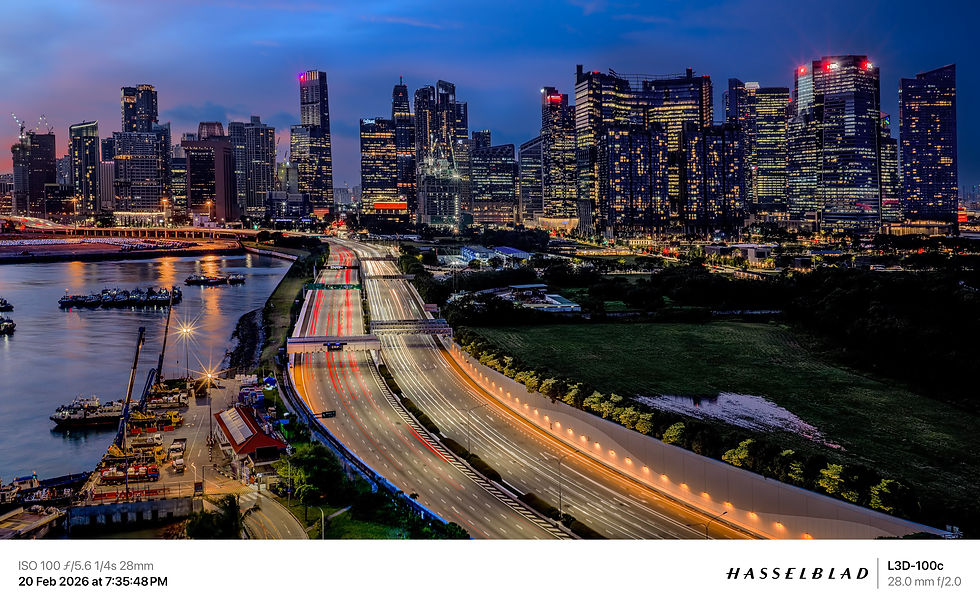
DJI Mavic 4 Pro | 100MP | 16:9 | 28.0mm | EXIF shown in EXIF banner | Cinema flight mode |
One of the reasons why I wanted to share my impressions on the Mavic 4 Pro's cameras was because there were so FEW reviews on the web focusing on Stills Photography. I could only find 1 well written review so far.
In this blog, I am going to share my Still Photography impressions comparing them to my previous still photography experiences with the DJI Mini 5 Pro, DJI Mavic 2 Pro and with mirrorless cameras.
Cameras on the Mavic 4 Pro Mavic 4 Pro image composite created from screenshots from DJI official website

The Mavic 4 Pro uses a triple camera system.
Main camera | 28mm |
100MP
Micro-four-thirds sensor
Aperture range f/2.0 to f/11.0
2nd camera | 70mm |
48MP
1/1.3" sensor
Fixed f/2.8 aperture
3rd camera | 168mm |
50MP
1/1.5" sensor
Fixed f/2.8 aperture
Image Quality from the 3 cameras - FIRST IMPRESSIONS
Cityscape on a rainy looking day with the 3 cameras
28mm main camera

Click on image for larger full size view.
Quite a "Worse" case comparison for a Micro-four-thirds sensor.
Very low contrast area being compared
Details were actually pretty good when viewed as a 28mm focal length image. The DBS logo was crisp & sharp. Detailings on the buildings can be easily seen even for the further buildings along the horizon.

Not a fair comparison but details like "Suntec" can still be seen which says a lot about the details rendering. Definitely not the best partly due to the very low contrast lighting conditions & the “unfair” magnification
70mm 2nd camera

Excellent performance with the 70mm camera.
The "Mandarin Oriental" & "Pan Pacific" words on the hotels can be easily seen . quite well focused & resonably crisp

Also magified over 500% , the building details are easily seen & read. Not the crispest but at this magnification, very acceptable.
Very nice job by the 70mm camera IMO.
168mm 3rd camera

Not the crispest but to get this image quality(IQ) level was much more than acceptable because of the potential to enhance the capture.
Also IQ will definitely improve in better light & when subjects have better contrasts AND most importantly do NOT forget the the DJI was hovering & wind gusts that day at 50m altitude was 39km/h. The slightest shake could easily be magnified at this mid-telephoto focal length. Given these contraints , I was actually quite impressed.

Magnification was greater than 200%
Details look excellent.
The screenshot below was > than 500% and details still looked very good. Pretty amazing for a "Flying" camera.

TIP | you will notice that when I used the 168mm 3rd camera, I actually used a FASTER shutter speed to minimize "shake" issues. I found that a lot reviewers did not quite like this 3rd camera , I suspect that many of them "forgot" to use faster shutter speeds to get crisp focus with less shake influence.
Image Quality from 3rd camera 168mm on a MOVING subject + More examples


Again in this case as the subject was moving , I increased my shutter speed to 1/500s
Details rendered by the 168mm camera was excellent ! as you can see for yourself in the screenshot when image area was 200+% magnified


This example was captured with the main camera at 28mm focal length
I again used a 2x "faster" shutter speed than the 1/28s recommended if using the reciprocal of focal length guideline to set shutter speed.
Flexibility of the TRIPLE Camera system of the DJI Mavic 4 Pro
From the 3 images below , the flexibility of the 3 cameras was very obvious. I do not have to pilot my drone to different altitudes hence I save time & have much lesser piloting risk.


LONG Exposure capability advantage of the Mavic 4 Pro over the Mavic Mini 5 Pro
With the 28mm camera , I can get 16 seconds exposure time if I used the sensor at 25MP , if I used the sensor at 100MP, I can get up to 8 seconds exposure time which is long enough for a flying camera !
For the DJI Mini 5 Pro, the longest shutter speed was 2 seconds in standard exposure for both it's 12MP or 50MP sensor modes.
Below was a Mavic 4 Pro blended image to get the image trails in
Base cityscape layer at 1/4 seconds
Traffic trails captured at 8 seconds exposure
SUMMARY of FIRST IMPRESSIONS (Stills Photography)
The stills photography performance of the Mavic 4 Pro camera system was definitely better than the Mini 5 Pro 1" sensor camera system. This was expected & not surprising.
Let me be brave here & do an unscientific comparison if I normalize my rating scale to a 10 for my Nikon Z8 + Z 28-400mm f/4-8 combo setup , here's my rating based on first impressions.
Nikon Z8 + Z 28-400mm | normalise to 10.0 |
Mavic 4 Pro | 7.0 to 7.5 |
Mini 5 Pro | 5.5 to 6.5 |
Again let me repeat, the ratings are based on first impressions & my post editing experience with their RAW files from the different camera systems.
Bottomline , both the Mavic 4 Pro & the Mini 5 Pro have very usable excellent camera systems given their physical, sensor & optical constraints , what this means is that the digital files (with proper exposure) generated are GOOD enough & more than meets my performance expectation of a good camera system.
I had NOT used my 1st generation Micro-four-thirds mirrorless Olympus OMD EM-5 sustem (released in 2012) for a while now , based on my memory & reviewing my images from the EM5 camera (yeah I know not apple to apple comparision) ....... based on impressions the camera system in the Mavic 4 Pro seems BETTER than the 14 year old system ..... files are crisper with better details & noise performance that is more than equal to the 16MP sensor in the EM5 (2012 version).
Bottomline , I am very happy with the still photography results I am getting from the Mavic 4 Pro. I also think that the cropped sensor cameras (70mm & 168mm) were definitely very usable & with appropriate post editing workflows can produce great images. Till the next blog, happy shooting ...... Andrew


Searching Sumba Timur travel options supports coordinated itinerary arrangements. Locations remain organized properly. Planning follows defined structure.